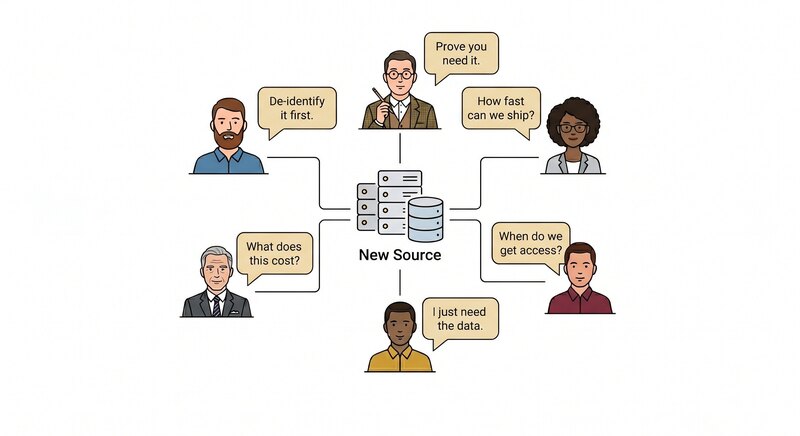
The Day Zero architecture for satisfying retention and analytical needs.
Published May 2026Audience Cross-functional leadershipReading time ~7 min
Privacy says: de-identify it first. Compliance says: prove you need it. Engineering says: how fast can we ship? Finance says: what does this cost? Analytics says: when do we get access? The data scientist says: I just need the data.
Paper 1 named why these voices conflict at the architecture layer. This paper shows the pattern that resolves it: an architecture decision made before the first byte of source data lands.
Block 1 · Day Zero is the architecture
The fork that solves the conflict
Paper 1 named four mechanisms and two problems. This is the architecture that separates them.
One hundred percent of the source payload lands once, at a fork point. This model assumes that data ingestion to the analytical store is approved based on documented use cases. The framework governs what happens to it after. From the fork, two independent streams receive the data. Stream 1 is the compliance vault: write-once, append-only, governed by Mechanisms 1 and 2 (legal retention and purge after the legal floor). Stream 2 is the analytical store: a medallion lakehouse, with Bronze (raw analytical store), Silver (cleaned, query-ready tables), and Gold (curated products used by analytics and applications) layers, governed by Mechanisms 3 and 4 (purge when no use, hard mask). After ingestion, the two streams are governed independently. Lifecycle actions in one stream do not automatically propagate into the other.
Figure D1 · Day Zero fork — source to two streams
The point of the fork is not redundancy. The point is that the two problems have different jobs. The vault carries the legal weight. The analytical store carries the analytical weight. When something has to give (a subject erasure request, a regulatory hold, a cost cut) it gives in only one stream.
This architecture reduces policy ambiguity at the cost of additional lineage, governance, and orchestration complexity. That tradeoff is worth naming before Day Zero.
Figure D8 · Relative storage volume by layer — illustrative
Single Origin
One hundred percent of source payload lands once, at the fork point. Both streams receive it independently.
Two Streams, Two Lifecycles
Stream 1 is the compliance vault (WORM, Mechanisms 1 & 2). Stream 2 is the analytical store (Bronze, Silver, Gold, governed by Mechanisms 3 & 4). After ingestion, the streams are governed independently.
The vault stream has a defined endpoint
When the regulated retention period expires, the vault record reaches the retention ceiling: a binary decision. Retain the underlying business event with identifying fields removed, on a documented analytical basis. Or dispose of the record in full. The standard for what counts as identity removal is defined and documented by privacy and legal, aligned to applicable regulatory obligations. It is not derived from any single regulation's safe-harbor language. It is the organization's own documented standard, attested and auditable.
Figure D6 · Retention Ceiling Gate
Retention Ceiling Decision
When the vault retention period expires, the record either retains the business event without identifying fields, or it is disposed in full. The identity removal standard is set by privacy and legal: documented, attested, and auditable.
Block 2 · What has to be true on Day Zero
Five capabilities the platform needs
The dual-stream architecture is the shape. These five capabilities are what makes it operate. All five are easier to build at platform launch than to retrofit later. Retrofit work runs in parallel with live data flows and adds coordination cost the original build avoids. Building capability before policy is written means the platform is ready to act when policy arrives.
Capability
What it means
Analytical store derives from source, not vault
The analytical store lands from the fork point independently. Vault disposal never propagates downstream.
Day Zero ingestion standard
New sources onboard through the same process. No bespoke pipeline design per source.
Telemetry-driven lifecycle
Usage signals drive promotion and disposal. The platform acts on evidence of use, not on the legal retention calendar of the vault.
Service-account-per-use-case
Each analytical use case authenticates through its own service account. Idle service accounts signal dormant use cases, which become candidates for removal.
Identity protection from Day Zero
Soft mask from Silver up. Hard mask for maximum risk protection per use case.
Five Platform Capabilities
All five are easier to build at launch than to retrofit. Build the capability to act on decisions before policy is written.
Block 3 · The pattern that enforces the commitment
Two non-negotiables
The architecture works only when two organizational commitments hold. All data flows through the platform: one ingestion point, no exceptions, no side channels. Vault and analytical store are designed together from Day Zero. Not the vault first and analytics retrofitted, not the reverse.
Organizations that take the architecture but skip the commitments end up with a source system that the analytical store has to create a separate flow to receive, or worse, the analytical store becomes a second vault that needs to meet vault requirements because it accumulated data the real vault did not.
The Organizational Commitment
One ingestion point, no exceptions. Vault and analytical store designed together from Day Zero. Not retrofitted.
Block 4 · The governance model that runs on top
Six ideas for the analytical store
The vault problem is largely solved by the architecture itself: write once, retain for the regulated period, dispose at the floor. The analytical store needs more. Six ideas govern how data lives, moves, and leaves the analytical store.
The Analytical Store Is a Governed Asset
Not a staging area for disposal. Explicit decisions about what stays, in what form, for how long, on whose authority.
Usage as the Governing Signal
Data is promoted on documented demand and dropped when usage ends. The platform monitors actual consumption through service-account telemetry. When a use case's service account goes idle, the data behind it becomes a candidate for removal. Hold what is in active use, in the form it requires, and no more.
Longitudinal Value
Some analytical data is worth holding longer because the time-series signal is the value. A ten-year cohort cannot be rebuilt from a two-year Bronze window. Longer retention requires a documented purpose, not just the absence of a deletion decision.
Minimum Identifiers
Gold-layer data products hold only the identifiers the use case requires. Not a full copy of source identity fields.
Recoverable Disposal
Disposal is designed to be recoverable before it becomes permanent: soft mask before hard mask, removal window before final purge. One caveat: disposal processes remain subordinate to active litigation hold, regulatory preservation, or other legally imposed suspension events.
Restore and Rebuild Must Account for Hard Masking History
A restored backup is not exempt from the lifecycle. Any hard masking or removal actions that ran after a backup was made have to be applied again on restoration. A backup that silently restores removed identity is a second vault the architecture did not intend to create. Restore procedures need to include a replay of all masking events that occurred after the backup timestamp. Not a trivial step, but unavoidable.
Identity Removal Is Risk Mitigation, Not a Certification
Hard masking reduces the privacy surface area of the analytical store. It does not certify compliance with any specific regulatory standard. The approach needs to be reviewed periodically with the Privacy organization. What the standard requires changes over time.
Over to you
How would you adapt this to your environment?
Paper 3 takes the architecture to its hardest test: a data subject erasure request. It shows why the same hard-mask process serves both routine lifecycle removal and an erasure request, when three platform conditions hold.
Cross-functional leadership (legal, compliance, data engineering, analytics) — LinkedIn series
Sources
The Author's original Analytical Data Lifecycle whitepaper (April 2026); external review: Gemini, ChatGPT, Perplexity; editorial decisions approved by author across sessions DL-S01 through DL-S12.
Decision / Action
First official published version. Publish one paper per week beginning with Paper 1.
Iteration Notes
v6.0: Final banned-pattern pass (DL-S12). Removed unsupported frequency claim (P1); removed "data minimization" label (P2); replaced metaphorical "data landscape" (P2); sharpened closing question (P2); removed contraction (P3). Version number unified across series at v6.0.
Assumptions
Images served via Google Drive thumbnail URLs. Publishing via GitHub Pages.
Scope Exclusions
Does not cover implementation playbook, vendor selection, or regulatory legal advice.
Tool Chain
Claude only — drafting, editing, HTML production across DL-S01 through DL-S12.
Review Status
Accepted — ready to publish.
Version History
v6.02026-05-12Final banned-pattern pass; series unifiedAccepted