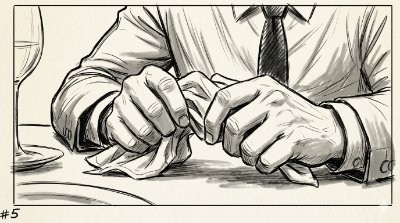
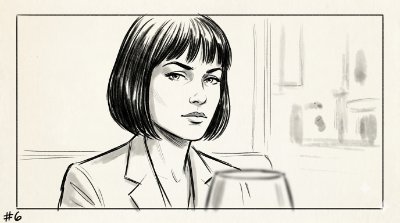
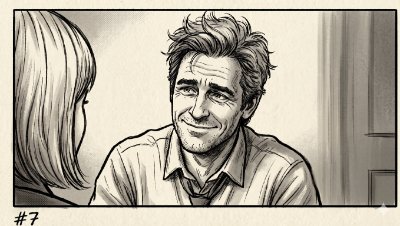
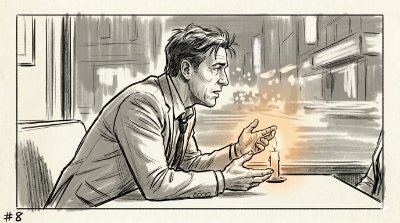
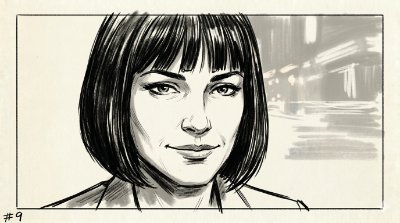
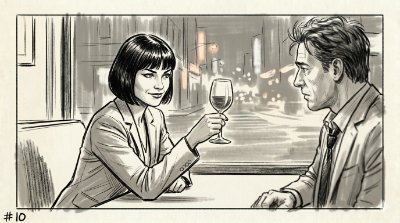
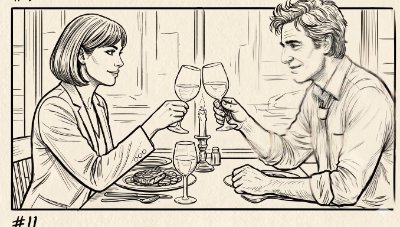
Treatment
The firm hired a dozen interns for the summer and could not figure out what to do with them. So they handed them to Luke.
They knew nothing. Not the clients, not the history, not where anything was kept. They learned fast. They never got tired. They were positive to a degree that unsettled people. And there were enough of them that Luke could finally do the parts of the job he never had time for. The second pass. The deeper research. The rigor nobody budgets for.
Most of the firm still treats them as a babysitting problem. Luke runs them like a team.
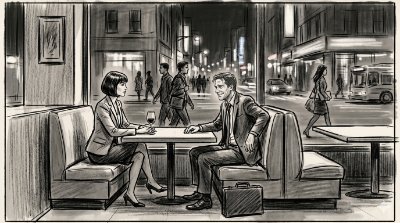
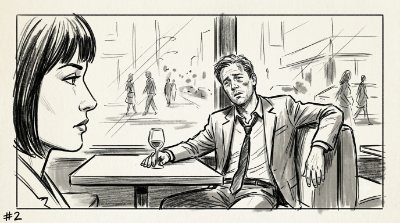
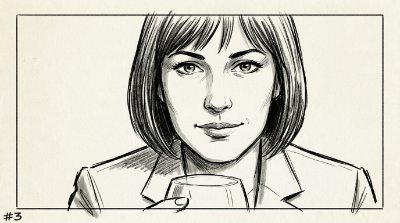
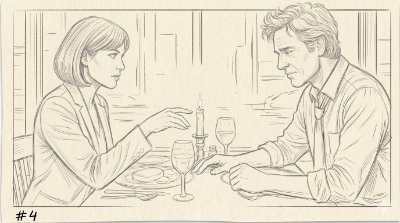
Each episode is one day with the interns. Tonight he has finished a long one. The piece is a big one: a signature argument about how these new AI tools are burying the world in slop. He is meeting Sandra for dinner.
What Actually Happened
The conversation was invented. The work behind it was not.
The scene above is staged. The events were last week.
I had a frame I could not make hold. I pushed on it across several sessions. The team pushed back, but only as far as I had stated the problem. The frame kept slipping. Not because the team was wrong. Because I had not yet said the thing clearly enough for either of us to know what we were arguing about.
When I finally said it clearly, the resistance changed. The questions got sharper. That shift was the signal. I knew the frame had moved because of how the pushback moved with it.
Then I asked for an outside view. I went in for a validation pass. It told me I was overclaiming instead, and it was right. I cut the claim down. Twenty-two rounds of markup. The paper came out built on a smaller, truer spine.
I could feel it when it started working. The questions changed. The pushback got more specific. There is a difference between a teammate who agrees with your frame and one who actually sees it.
If you have read this far you already know the team is not people. Here is the scene, translated:
| In the scene | What that actually was |
|---|
| “They knew nothing.” |
A new chat starts blank. You give it the full context or it works from guesses. |
| “Positive to a degree that unsettled people.” |
The model stays upbeat and agreeable. That is the reason it will ride a bad frame without flinching. |
| “One of them started to drift in a long meeting.” |
A long thread fills its context. The work loosens the longer you stay in it. |
| “An outside view. Someone with no history.” |
A new chat. Separate model, blank context. |
| “Lay it out again from the beginning.” |
The red team gets a clean read, but you need to orient it again to the problem you wanted to solve. |
| “The pushback got more specific.” |
A fresh context has no stake in the frame I built. |
| “It told me I was overclaiming.” |
A reader with no stake caught the claim I was inflating. The smaller version was the true one. |
| “Treated as a babysitting problem. Run like a team.” |
The tools run wild if no one directs them. Lead them and the work changes. |
Most people never get near this. They write one good prompt, take what comes back, maybe push once or twice. They use the tool to produce. They never use it to attack the work, or to attack itself. That critic is sitting right there, and it is free. The sharpest version of it is the one with no memory of what you built, because it has nothing to defend.
Pro Tip
Red Team: put a critic on your team.
When you are close to done and too invested to see straight, open a blank thread in a totally different chat tool. Give it the work and the right prompt and tell it to find what is wrong. No history, no loyalty, no stake. That is the teammate who tells you the truth.
One habit inside a larger one: leading these tools like a team, not writing a prompt and walking away. → A Team You Have to Build and Lead
Provenance
Cast & Crew
Director · Final Cut
Hugh McCutchen
Drove all three sessions. Made every cut. Carried the context across the threads so the team didn't have to.
Lead Writer · Structure
Claude Opus 4.8 (High)
Called the series-over-paper architecture. Built the bridge, the decoder, and the Treatment. Ran the naming passes and the final assembly.
The Stuck Room
Claude Sonnet
The project thread analyzing the work, where the argument would not break. The film starts because this room could not crack it.
Red Team · Script Doctor
Claude Opus, fresh thread, no project
Read the work cold. No memory, no stake. Caught the overclaim the stuck room had been defending. Same actor as the lead writer, different room, no loyalty. That is the whole point.
Storyboard · Illustration
Gemini
Visual direction and the eleven panel frames. Handed over the term “murder board” for a later scene.
Casting Note
Luke and Sandra played by no one. The interns played themselves.
Version
v3.5
Sessions
TeamStory S01–S03 · three sessions, many turns each
How it got here
Began as a bridge rewrite for a paper titled “Interns Are Awesome,” Episode 3 of “The Layer No One Sees.”
Reframed from one large leadership paper into a single scene in a series. The movie became “The Interns,” this scene “Red Team.” Episode numbers gave way to named scenes.
The bridge was rebuilt: the vending-machine metaphor was cut, a scene-to-mechanic decoder table replaced it, and the close moved to the free critic.
Naming passes: Setup became Cold Open became Treatment. “Hire the critic” became “Red Team.” The red-team / murder-board line was held, with murder board reserved for a future scene.
The core beat was reframed from process to thesis: not “starting over fixed it,” but a reader with no stake catching an overclaim. Grounded in the real event, a stuck Sonnet project thread left for a blank Opus thread.
Visual language settled last: a dark-brown 35mm film band brackets the fiction, burnt-orange Claude splats bracket the real advice.
Sources
Session dialogue TeamStory S01–S03 · the real red-team exchange (Sonnet project thread → blank Opus thread) · Capstone OMUP v2.8
Open items
Driving with a Stick URL to confirm · A Team You Have to Build and Lead URL to confirm · Capstone live URL to confirm
Assumptions
Luke and Sandra are fictional. The argument and the red-team event are real. The model facts (Sonnet → Opus, fresh thread, no project) are as they happened.
Version history
v3.5 · Mobile layout (panels and tables stack on phones, tablets unchanged) · share-preview Open Graph tags added
v3.4 · Header image set behind the cover under a legibility scrim
v3.3 · Provenance rebuilt as Cast & Crew credits and a three-session arc
v3.2 · Overclaim beat across Panel 9, decoder, and bridge · Claude-splat pro-tip band · panel images wired to repo
v3.1 · Rebrand to The Interns / Red Team · Treatment card and film band · eight-row decoder · Further Reading split
v1–v2 · Eleven-panel screenplay built (S01–S02), bridge placeholder