About Bursera Consulting

How the practice came about, and what the method actually looks like in use.

The name
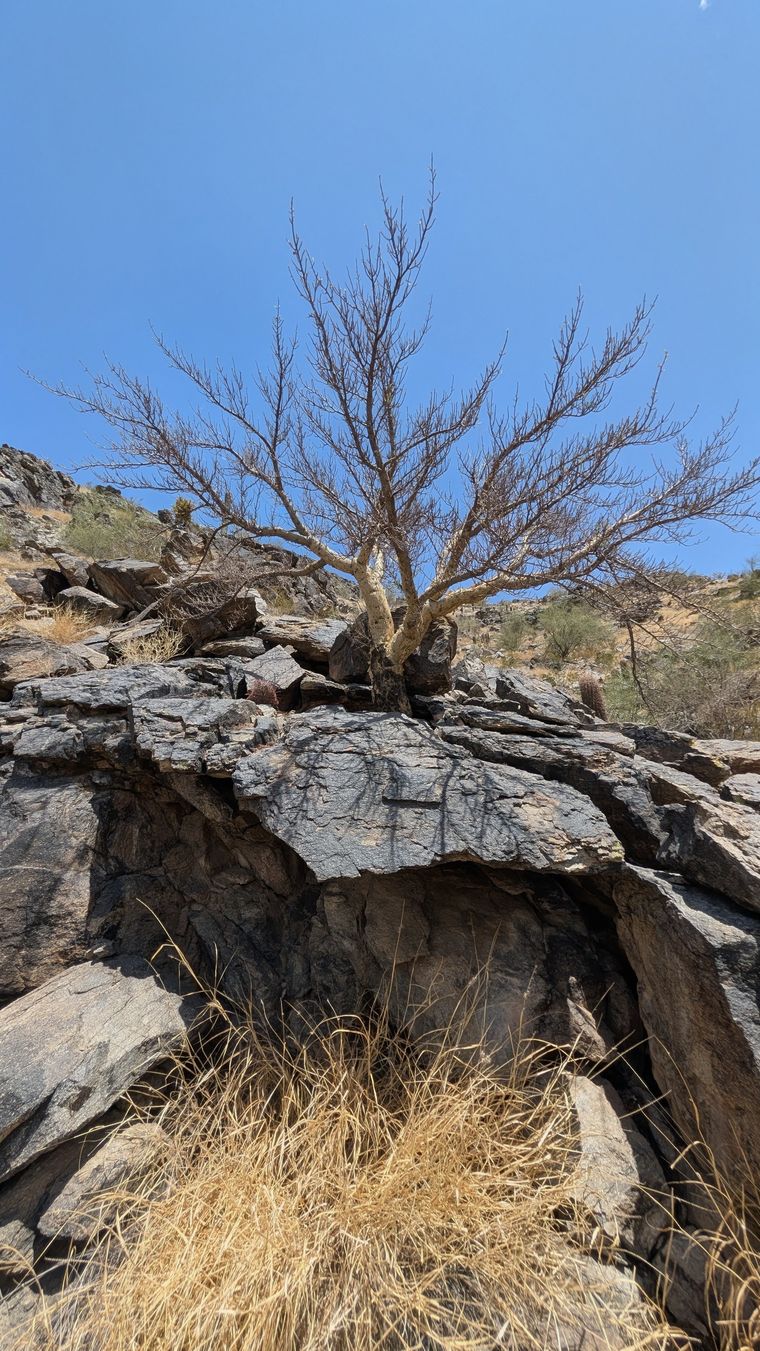
A bursera — the elephant tree — growing from the rock on South Mountain, Phoenix. Photograph by Hugh McCutchen.

South Mountain is one of the world’s largest city parks, with more than a hundred miles of trails, equal parts magical and desolate. It carries traces of the Hohokam people who lived there for centuries before anyone else arrived: petroglyphs, lithics, and sherds still scattered along the paths. I hike those trails to ground myself in what is timeless.

The bursera tree seemingly grows straight out of the rock. I know it by the common name the elephant tree and is a member of the frankincense family. Its trunk is stout, white, and flaking, with heavy branches that twist and then taper into a sparse crown of tiny leaves that are easy to miss. The tree’s sap (copal resin) was burned as incense and it is studied today for medicinal use. The Seri, desert people to the south, would chew its berries to quench thirst. Finding a bursera on the mountain is still a treat.

Paying attention to the mountain that way takes the same attention the research demands: understanding how a problem branches, and noticing the small details that turn out to matter.

How this came about

For the last two years these LLM chat tools have been a puzzle. It was easy to see straight away that they were better at finding and synthesizing information than any person or any team. They were also forgetful, prone to making things up, and capable of getting lost entirely.

I spent most of the last year on understanding why, and on finding the openings to overcome the problems and press the strengths as the tools themselves matured. The path ran from treating chat as somewhere to pull chunks of information from, to treating it as a thinking partner, to treating it as a workspace — a place where research, analysis, diagramming, writing and validation all happen fully enfolded within the chat experience, with each step of the work governed, logged and empowered by the tools.

It was very hard to do successfully at first, and it has required building up a platform — so that the researcher stops thinking about the tool and can focus on vision and judgment, with good habits and process underneath.

The result comes out better. That is the whole of it: this is not the automation of the work. It is extending the power and skill of what any researcher or analyst can do.

What that means in practice

An engagement runs inside a documented method and a platform that holds the analysis together across days of work and hundreds of sources. A lead analyst sets the problem, directs the work through its parts, checks the findings against their sources, and decides when it is ready to leave the desk. Nothing leaves without that judgment on it, and the record of how it was done travels with it.

Bursera offers this three ways. Research — you bring a question and we build the evidence base under it. Training — we teach the practice to the researchers, analysts and leaders who want to run it themselves. Advisory — we help leaders size where these tools fit and build LLM-leadership thinking in their own organization. The method and the platform sit underneath all three.

Who is accountable

I’m Hugh McCutchen. I founded Bursera after twenty years leading complex technical builds through teams of capable people. Every engagement is led by a named analyst who directs the work and stands behind it. The judgment is the point, and it is never anonymous.